Sunday, 31 March 2019

Investing in our Career (Taking care of the goose)

  Posted at  March 31, 2019 6 comments


There was once a farmer who owned a prized asset: Le' Goose!  This was no ordinary Goose. The farmer took care of the Goose, feeding it and tending to its needs daily. Behold, each morning when he checked the Goose pen, inside was a shimmering, shiny Golden Egg!

Each afternoon, the farmer went to town and sold the egg. The consistent money received from the sales of the golden eggs soon allowed the farmer to live comfortably. However, the farmer started to get annoyed that the goose only laid ONE EGG per day.


"It's far too slow! I need to get more golden eggs to get rich faster!" 


He devised a plan to finally kill the goose to harvest all the golden eggs at once by cutting its belly open. However, when he did kill and cut open his goose, there was not a single egg to be found.

---------------------------------------------------------------------------
tl:dr (too long didn't read version):

  • Expect the unexpected in our careers (it might not always be smooth sailing)
  • Take care of our golden goose (Plan A), make plans and also backup plans (Plan B).
  • Don't do things that are dealbreakers (kill your golden goose prematurely)
  • Upgrade yourself, invest in "fattening" our golden goose. (Skillsfuture can be an option)
  • Keep your desires in check (the farmer inside us)

---------------------------------------------------------------------------

This is a famous story from Aesop's fables that warns against the perils of Greed and incredible short-sightedness. In the above story, the farmer made an irreversible loss by taking an action that seemed logical but was actually myopic in his hindsight.

We each actually have a goose that lays golden eggs. Most lay a golden egg a month. Some do better and lay eggs more than just once a month. Some people get small eggs while others get big eggs.

When we analyse the parable, there are 3 important things.


  • Goose: Our asset that generates consistent income.
  • Farmer: Our desires/wants in life that consumes the income.
  • Golden Egg(s): The consistent income (reward) for taking care of our asset.

Having a job is different from having a Career. A Job simply gives us money in exchange for our time. A Career, on top of giving us money in exchange for time would require more planning and thought out process to grow, improve, "fatten" up the goose. And in time, the Goose aka. our main asset in earning an income grows to give a greater output and satisfaction in life.


Why is keeping the delicate relationship of the 3 important?

  • Having a stable income generated leads to the ability to save.
  • The ability to save in a disciplined way leads to the possibility of gaining more assets.
  • Taking care of the goose increases the output(s).
  • Keeping the desires of our internal "farmer" in check ensures that we do not kill the goose prematurely.
  • Putting the Golden eggs earned to good use is a must because it is a limited resource.


Recently, there were two main events that happened around me that crystallised the importance of planning ahead. (Stories have been slightly altered but retains the essence)

1. Retrenchment at workplace
2. Misfortune of a close friend

Story #1: Retrenchment at workplace.

This is a story of how a "natural disaster" can kill our golden goose like how Thanos decides to snap his fingers.
Sarang Hae~ *snaps*
Two of my colleagues were asked told to leave without any warning whatsoever with only about 2 hours notice. This event hit me and my colleagues hard. We were always told our company was doing well. Suddenly, we realised the fragility of our jobs and how we could not take them for granted. In the fast moving globalised world, we could be replaced any minute and have nothing to fall back on.

There were some lucky ones who might go through a similar ordeal which turns out to be a blessing in disguise and ended with a better paying job but many others will not be as lucky and still remain jobless.

Nonetheless, it must have a great mental torture and stress through the ordeal of loosing the goose.

Question: Do I (we) have a backup plan?

Story #2: Misfortune of a close friend

I have a friend who works himself very hard to find more avenues of earning money. So he did a part time delivery in his spare time. However, he lacked sleep and was burning candles on either side to squeeze more golden eggs from his goose. He started to turn up late often at work and turned in work with poor quality.

Life is not a game. You can't just save and restart again.

One evening, he went out on that part time after his day job as usual.

Unfortunately, this time, his concentration lapsed and in a split second, he got into an accident. He suffered injury and loss time which affected his main work and instead of earning money, had to pay for his medical bills. Worse, his employers were not thrilled about his moonlighting.

It was of course easy to make hindsight comments but it is probably fair to say it probably wasn't worth it and my friend has to shoulder part of the blame for his situation.

Question: Are we getting more than we bargained for in a bid to rush the golden eggs?

---------------------------------------------------------------------------

What are we planning/doing so that we can take care of our Golden Goose better? 

Story #1 was probably a good example of how we could lose our goose without our fault. Story #2 was probably an example of how wanting to earn more can backfire when we pushed ourselves to our human limits (there are just 24 hours each day and we can't trade rest time without suffering consequences).

Events like these make K.C. think. Barring actions that shoot ourselves in the foot, of course ideally, we would want to plan for our careers in such a way that we grow our income and achieve advancement/promotions at work. But to do this requires us to plan ahead to know what we want. This would be best if we already know what we want to do in the future.

If what is going on around the world is a good yardstick, my take is that our diplomas and degrees will be worth lesser in the future. This is because more people are getting them, this "cheapens" the worth of our degrees despite us having paid a handsome sum to get them. There are now many graduates around the world who have been taught this age old method of: Study hard, get a job and be set for life. The only thing is that many are not getting employed because companies don't need their skills and they are out of luck.

In my opinion, the degrees are still likely useful as an entry point, but thereafter accumulating experience and professional certification become much more useful.

In an ideal world situation:

Education >  Work/Career > Experience + Professional Certs > Advancements.

However, most of us might not have crystal balls and don't have an inkling of what we want in life early on. By the time we work, we might already be doing what we do not like. Commitments in life also make it tough to go for career switch and events like retrenchment would be doubly painful.

The next best possible thing we could do is probably to plan realistically based on our current situation.

What could one do to minimise the impacts of unforeseen circumstances? 

For circumstances like retrenchment, one can practically:


  • Cut down on unnecessary expenses. e.g subscriptions
  • Downgrade lifestyle if possible (but not burning another side of candle)
  • Keep an emergency fund of at least 6-9 months of living expenses in the bank
  • Start thinking of Plan A: Building a career advancement (so you are not easily replaceable)
  • Start thinking of a Plan B: In case you are retrenched.


What could one do to increase employability/advancements?

Well, the next better thing we could do is to upgrade/diversify our skill sets so that they contribute to our careers or act as backup plans. Maybe the recent happenings were a wakeup call to not be complacent. Either way, it beats staying in comfort zone.

Skillsfuture (This is not a sponsored post)

Source: https://www.skillsfuture.sg/Newsroom
In 2016, Skillsfuture was set up in Singapore to encourage Singaporeans to have a "lifelong learning" attitude. Singaporeans aged 25 and above were given a one time $500 credit and are eligible for subsidy if they sign up for courses that improve themselves. SkillsFuture also pour $1billion a year of our taxpayer money on initiatives such as career guidance for students, enhanced internships, and subsidies for mid-career learning, among others.

I was considering taking masters/ recognised courses especially in the wake of the company's retrenchment exercise and it was honestly one of the first time I took a look in detail at the courses offered. The amount of subsidy was quite high for certain courses and one receives more subsidies if he /she was older than 40.

As it stands, barring the scandal that cheated the government of $40million, many Singaporeans like myself still have not utilised them for a variety of reasons.

I would personally encourage our fellow Singaporeans to take a detailed look to see if any course would help in your career. If you are already doing well in your career, you might want to use it to take a course that improves a hobby (e.g. photography). There is nothing to lose here, well, maybe some time commitment.

Recently, some of my friends also started to take IT classes in Singapore polytechnic as a plan B as well as to keep relevant.

K.C. recently went to NTUC training hub to sign up for a one year course.
A wide variety of courses available to choose from.
The well-built Devan Nair institute at Jurong East (Employment and Employability Institute) speaks volumes of how much funds our government has poured into creating all the Skillsfuture ecosystem.

Singaporeans like myself are a bunch that likes to complain. The question is after complaining, what are some actionable steps we have taken to improve ourselves? Will your future self be grateful to you?

Until Next Time, 

K.C.
If you like this post, you might like our facebook page as well. I'm also on Investing Note.


Disclaimer: The views expressed, opinion and information in this article are strictly for informational purposes to encourage educational discussions only. It is important to conduct your own analysis before making any investment decisions based on your own personal circumstances. You should take reasonable measures such as seeking independent financial advice from professionals and/or independently research and verify the information that you find on "30 Year Old Investor" before undertaking any important investment decisions. No content on this site constitutes - or should be understood as constituting - a recommendation to enter any securities transactions or to engage in any of the investment strategies presented in our site content. We do not provide personalised recommendations or views as to whether a particular stock or investment approach is suitable to the financial needs of a specific individual. No representation or warranty expressed or implied is made as to, and no reliance shall be placed on, the fairness, accuracy, completeness or correctness of the information or opinions contained on this website. "30 Year Old Investor" shall not be liable whatsoever for loss or damages of any kind arising from the result of any use, reliance or distribution of the articles or its contents from information contained on this website. 

Sunday, 10 March 2019

Creative: My (un)biased analysis on Sxfi and Shares

  Posted at  March 10, 2019 3 comments
In this review I will mainly analyse 2 things:
1. Creative's new S-XFi tech
2. Creative technology's C76 stock.

Creative: 
The company that survived transitions.

Creative is a brand-name that rings a bell for many Singaporeans. Set up in 1981, it has seen its fair share of success in its Sound Blaster cards to its "challenges" in fighting Apple over patents (its Zen Touch vs the Apple Ipod.) How has Creative managed to survive it all is no simple feat and as K.C. researched into its history, one cannot help but be inspired by its story. It has now survived long enough to launch its next big thing: The Super X-Fi range of personalised audio holography.

He that fights and runs away, May turn and fight another day; But he that is in battle slain, Will never rise to fight again. - Tacitus

OKAY. So, K.C. saw extensive reviews online since last year on Creative's new Super XFi technology and fellow users at Investing Note have been recommending it as well, especially its new Super xfi Air headphones. K.C. therefore decided that he had to go to the IT fair on 8/3/2019 to see and hear the hype for myself.... and ended up going home with a pair of new Super xfi Air headphones.

K.C. would like to say that he is un-biased but having bought the technology and its shares before K.C. will leave you as the reader to decide for yourselves if his analysis is indeed biased.

First off, K.C. would just like to say that Creative (SGX:C76) is one of those stocks that he burnt almost $1,000 in trading as a newbie investor and he will share a little more of how that came to be and the lessons learnt from it. So in fact, K.C. has a reason to post negative reviews (but of course I'm not going to la)! 😂😂😂

Anyway, don't take my word for it! Go to the IT fair and hear it for yourselves!

tl;dr (too long, didn't read) version:

I'm probably very excited about the tech as an end user, but not so much from an investor point of view about its shares. This company will probably still continue to survive the next 10-15 years.

1. Creative's new S-XFi technology is indeed a value for money product that targets the mass market. The survivability of the business has been centered around constant innovation, patenting new technology arising from its R&D and moving into higher end consumer market. As an end user of its holographic audio series of product, I have to say, I'm honestly impressed and am enjoying the joy it brings to my late night entertainment without having to disturb my family.

2. Interest in Creative technology's C76 stock price has been more or less highly speculative because as of now we have not seen the new technology bring in consistent profits for Creative (yet). From a business point of view, the company is likely to survive the next 10-15 years given its direction in constant R&D and how it smartly patent its technology. From an investing point of view, the company's financials have not been doing so well for some time since its fall many years ago. Revenue has been constantly dropping over the last few years with challenges in the consumer market. It remains to be seen whether the award winning technology can indeed breathe new life into the company's financials and share price. Holographic audio is perhaps a new area but the headphone market is dominated by big players that Creative have to navigate and overcome to establish itself.

Below are some of K.C.'s thoughts on why this is so.

Long version:

HEADPHONES/SXFI TECH

Tucked away on the 6th floor of the IT show at Suntec Convention Hall 601, from 7-10 March, the IT show pulled in crowds while some other stores beside had only a few customers (pictures will prove my point later). As of posting of this article, you still have a few hours to hear it for yourselves at the IT fair.

The IT show really tells us why the new products are such a success.

Why is it such a hit? (The Pros & Cons)

1. Affordability:

At around $200, the products fall within the affordable range for most consumers. Good move.

  • S-XFi Amp Deal $199 comes with a certified Aurvana SE headphone. (Dongle)
  • The new headphones are probably worth your money at $219
    (IT show price and comes with free earpiece). Don't take my word for it. Hear it for yourself.
  • Brochures for other products can be found here.


2. Functionality, design and experience:

Sim Wong Hoo and his team have seemingly put alot of thought into the design, user experience, marketing to target the mass market, aka. People of all ages. The overall design is classy and simple. After using it for a night, I can say that the user interface is mostly intuitive. The connections for the headphone is more straightforward compared to the Dongle Amp which is surely a plus going forward. Sim Wong Hoo seems to know what he is doing and where all these is leading. The goal is clear: to provide a fuss free and clean user experience with the new holographic audio.

S-XFi Amp

S-XFi Air. The white ones have been sold out! 

  • S-XFi Amp: Some older folks loved the 3.5mm Dongle Amp because it features a 3.5mm standard ear jack which means they can connect it to their old mp3s.
  • S-XFi Air: This is no doubt the highlight of this IT show given that many young users have been asking for this. The wireless bluetooth headphone that features touch pads on the left side of its ear cup (which allows you to turn up and lower volume, change tracks or receive calls)
  • S-XFi Air-C: USB headset for gamers. 
  • Compatibility: The new range of products are widely compatible with a host of popular entertainment products such as the Sony Playstation, Nintendo Switch, Windows and Mac as well as the highly lucrative mobile devices segment. The SD card slot was supposedly insisted by Sim, but might not be a bad idea after all since one can store alot of songs on an SD card these days.

The holographic audio is indeed quite revolutionary, especially when you turn surround sound on for your computer. The difference can be immediately felt. Given that companies like Apple have manufactured phones with no more 3.5mm Jack, the bluetooth connectivity is also a plus.
Turning the surround option on worked wonders on my new S-XFi headphones.

3. After sales/support:


As can be seen in the series of pictures below, the turquoise blue shirts are the sales staff who provide very important support during the fair:

  • Payment of the products can be done via online, cutting queue times.
  • The main con here is that the headphones need manual setup with the SFXI app on playstore or on the App store to scan the user's ear profiles. This can prove a little difficult for some of the customers. But this is where the sales staff shine.

Sim Wong Hoo even came down personally to the IT show to help customers with the products today probably yesterday! (Too bad he wasn't there on Friday) I spoke to many of the sales staff and some older staff who have been with Creative for a long time and they confirmed that Sim is a really humble and down-to-earth CEO. Immense respect for him.

https://mothership.sg/2019/03/creative-sim-wong-hoo-it-show/

Sim Wong Hoo at the IT fair. Source HWZ.
K.C.'s snapshots from IT show
There were many buyers of all ages of the new Tech at the IT fair. A good sign to me.
A well-rehearsed sales speech delivered with Live demonstration to WOW the audience.
The crowd and interest is real. 
The crowd speaks for itself.

Creative Technology Stock SGX: C76

Moving on to Creative shares, I'm really impressed with the way the business is run because it survived so much over the years. From its founding in 1st July 1981, it as seen its fair share of successes mainly due to its 1989 Sound Blaster device to being publicly listed on the NASDAQ in 1992 on the back of its successes on the cards.

From 1996 to early 2007, it suffered some setbacks and also most notably known for its legal fight with Apple for infringements relating to user interface technology in its Zen touch vs Apple's Ipod. While it got $158 million from Apple as a one-time licensing rights, it lost sales, delisted and cut back on operations and jobs.

It has since continued to innovate to stay relevant with a range of other products most notably its recent Super X-Fi Technology. One good thing I like about Creative is the way it focuses on R&D and patenting its technologies to protect itself. It also has no outstanding debts, which is a huge plus for any operating company. (Look no further to Hyflux for a company who imploded itself with aggressive debt loading to expand its business)

Creative's Timeline History can be found here.

First off,  as mentioned Creative was one of those stocks I burnt a painful hole in my pocket during my first year as an investor. This was largely down to my short term trading strategies and inexperience in chasing a stock that had already run up in a FOMO (fear of missing out) manner.

Creative shares "exploded" from $1.20s range to almost $10 back in March 2018. This was prior to the launch of its Super X-fi Amps in September. I remember buying at around $6 thinking it might just go back higher. This was a huge mistake at that point of time because the physical product had not been launched. Creative was still on the back of dropping revenues/ profits which meant that it had not overturned its years of losses despite it being debt free.

*One important point of note was that the revenue from some of these years could be from patent legal claims and not from sales of its products which we ought to be more interested in. Discounting this would probably mean a worse figure while overall cash flows are still negative.

Again, however, the good thing is that Creative has no debts despite its dropping financial statistics:

Creative's Total Revenue in millions since 2015. Source SGX.

Creative's Gross Profit in millions since 2015. Source SGX.

Creative's Net income and Cash Flows in millions since 2015. Source SGX.

Creative shares "exploded" from $1.20s range to almost $10 back in March 2018. It closed $4.90 on 8/3/2019.


Lessons learnt for K.C. :


Never ever chase stocks that have run up (for short term trading).
- Margin of safety is compromised/lesser
- Room for more increase is limited
- Others would be profit taking

Looking back, many investors/short term traders profiteered from speculation of the highly anticipated super xfi product. I'm sure many were also burnt in the process who were blindly following, late to the party and not understanding what was happening (myself included).

Indeed, at this point of time, given the financials of the company, buying Creative's shares is akin to taking a punt and gambling that it will start to show some success in its newly minted crowned jewel product - the Super X-Fi. Like I mentioned above in my summary of the tl;dr version, Creative still has a lot of ground to make in terms of establishing itself in the hotly contested headphones arena which are dominated by many other big brand names selling high-end digital audio products.

Creative as a company can definitely survive. The share price is however another matter altogether.

If there is any encouragement, the response from the IT fair looks favourable indeed.

More astute and long term investors would likely adopt a wait-and-see attitude to see if the numbers show a turnaround. And at this level, Creative shares might not seem a very enticing stock to invest in given there are other choices while waiting for it to show signs of recovery.

I for one, certainly hope that a local brand like Creative would soar again.

p.s. Vested for short term punt.

p.s. Another of my favourite local SG brand: Secretlab chairs!
Until Next Time, 

K.C.
If you like this post, you might like our facebook page as well. I'm also on Investing Note.


Disclaimer: The views expressed, opinion and information in this article are strictly for informational purposes to encourage educational discussions only. It is important to conduct your own analysis before making any investment decisions based on your own personal circumstances. You should take reasonable measures such as seeking independent financial advice from professionals and/or independently research and verify the information that you find on "30 Year Old Investor" before undertaking any important investment decisions. No content on this site constitutes - or should be understood as constituting - a recommendation to enter any securities transactions or to engage in any of the investment strategies presented in our site content. We do not provide personalised recommendations or views as to whether a particular stock or investment approach is suitable to the financial needs of a specific individual. No representation or warranty expressed or implied is made as to, and no reliance shall be placed on, the fairness, accuracy, completeness or correctness of the information or opinions contained on this website. "30 Year Old Investor" shall not be liable whatsoever for loss or damages of any kind arising from the result of any use, reliance or distribution of the articles or its contents from information contained on this website. 

Sunday, 24 February 2019

When investments go south: Painful lessons to learn

  Posted at  February 24, 2019 No comments
15 min read


Investors lose money all the time. It is not the first time and it won't ever be the last. Often, retail investors who couldn't afford to lose their hard-earned money fall victims to their own greed and are also done in by their utter lack of due diligence/incompetency in the investments they put their money in.

Many lost money through unregulated investment schemes and frauds hatched to swindle money. But, what about the "supposedly regulated" stocks or securities listed on the SGX, the bond market supposedly governed by regulations in Singapore? This certainly raises eyebrows.

Curious case of a retiree parading outside a local bank. Just what did he invest in?
Sounds like very poor due diligence.
As a frequent reader of 30 Year Old Investor, you would know by now that K.C. always advocates against putting our money with unregulated "alternative investments". As shared in a previous blog post, I suggested that we avoid MLMs or such investment schemes at all cost because they usually show these red flags:

  • High guaranteed returns (Too good to be true)
  • Short time frames of investment
  • Limited time offer (artificial scarcity)
  • Introduce more friends to get kickbacks
  • Not regulated by MAS/on alert list

And indeed from time to time, we see some of these unregulated alternative investments implode and make the news:

Case in point: Sunshine Empire
https://www.straitstimes.com/singapore/courts-crime/guilty-as-charged-sunshine-empire-duped-investors-james-phang-wah-2006
Sunshine Empire was an elaborate Ponzi Scheme set up in 2006 that cheated investors a total of almost $190 million. Only $21 million was recovered.

Victims of the scam told local newspapers at the time that they had been "naive" and "stupid".
"I was naive and foolish," one undergraduate told The New Paper. She had put in $66,000 into the scheme, using money borrowed from her parents. "I really thought it was easy money."

Case in point: Macro Realty Developments 
https://www.straitstimes.com/singapore/courts-crime/sporeans-victims-in-australian-ponzi-scam
This Australian based Ponzi scheme that raised approximately A$100 million (S$107 million) had 981 investors from Singapore, 651 from Malaysia, 58 from Britain, 17 from continental Europe and 31 from Australia. (2014- 2016)

Said a female corporate executive who had invested in the scheme for long-term gain: "I am distressed and devastated, and trusted too much in the system."

Case in point: Profitable Plots
https://www.asiaone.com/singapore/profitable-plots-case-directors-jailed-3million-scam
Investors lost around $3.1 million in the Boron bonds scheme between November 2008 and August 2010. The two directors of land banking firm Profitable Plots promised 12.5 per cent in returns within six months.

Case in point: Ecohouse Group
https://www.straitstimes.com/singapore/housing/too-good-to-be-true-property-deals-that-turned-sour

London-based EcoHouse enticed many investors with its unique proposition of investing in social housing in Brazil. Investors were asked to shell out at least £23,000 ($47,150) in exchange for an impressive 20 per cent fixed rate of return for a 12-month contract. The scheme reportedly attracted over 2,000 investors globally, while at least 800 people in Singapore were said to have ploughed about $65 million into the scheme since 2011.

But, what about the "supposedly regulated" stocks or securities listed on the SGX, the bond market supposedly governed by regulations in Singapore?

Are you seeing a pattern here? It is always amazing how such plots and schemes repeatedly lure unsuspecting investors. However, if we think investing in regulated securities means we are much safer, we couldn't be more wrong. A combination of changing markets can just as easily sink companies that are not so prudent.

Most recent case in point: Hyflux
Lauded as the success story of Singapore, Olivia Lum founded Hyflux in 1989 with only a mere $20,000 and Hyflux has grown to become a leading player in water treatment responsible for 30% of Singapore's daily water needs. It was a much celebrated story.

Prime Minister Lee Hsien Loong at Hyflux's Tuaspring official opening. Source: ©Hyflux Website 
There was a huge endorsement by the government. Even the Prime minister gave his stamp of approval over the years and was there for the opening ceremony for the Tuaspring plant back in 2013. What can go wrong, when such a "successful" company issue preferential shares and perpetual securities offering high yields? Of course they were well sought after, to great devastation for some of the retail investors many of whom were retirees.

https://www.channelnewsasia.com/news/business/a-big-shock-retail-investors-in-singapore-caught-out-by-hyflux-10407930


Seen as one of Singapore’s most successful business stories, water treatment specialist Hyflux’s recent woes had come as a shock for many and for Mrs Goh, it was something that she had not seen coming.

Lured by an attractive 6 per cent coupon, she had put in S$10,000 into the company’s preference shares issued in 2011 at S$100 apiece.
Both tranches saw strong demand when they were issued, attracting yield-hunting retail investors who subscribed through ATMs. Mr Nallakaruppan said he knew of investors who had put in S$200,000 or more, with retirees among them.

“Interests rates at the banks were just far too low and because of that, a lot of the investors were hunting for yields,” he said. “They also see Hyflux as a growth company dealing with an important resource.”

Hyflux's profit/revenue and ROE from 2008.

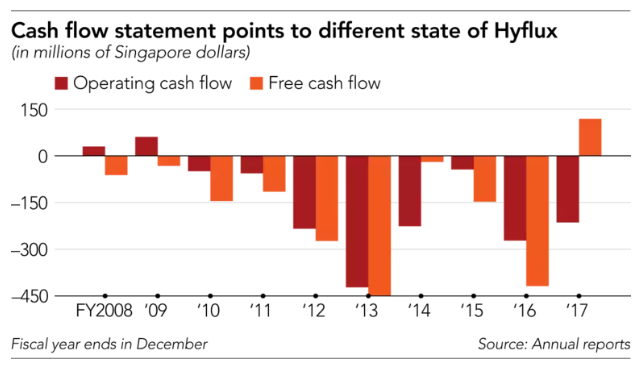
Hyflux's Cashflow from 2008.

Hyflux's growing debts over the years.
Years of risky and aggressive expansion has seen Hyflux take on more debts than it can handle. In fact, Hyflux has seen certain red flags over the years largely on its dipping profit margins, ROE and negative cashflows since early 2010.

Mismanagement of debts?
Notwithstanding the struggle to turn profits, Hyflux's management also did a series of baffling decisions over the years. This included continuing to give out dividends especially including a relatively higher dividend yield of 4.82% in 2018 despite its financial situation. If it was mired in debt and had little cash flow from which to dish out dividends from, where do the dividends come from?
Hyflux's Dividends declared from 2010 (StocksCafe)
On 11 Feb 2019, Investor watchdog asked Hyflux to explain why huge dividends and executive salaries, benefits and bonuses were still paid. All this despite Hyflux being in debt and not being profitable.

Apart from the more than S$60 million in dividends, Mr Gerald noted that Ms Lum also received “significant salary, benefits and bonuses” and earned between S$750,000 and US$1 million in 2017. In Hyflux’s annual report, key executives were said to have had received a total remuneration of S$2,695,134.20 for that financial year. 
“(This was) a year which Hyflux reported losses of S$115.6 million and a period which was five months prior to Hyflux Group filing for court protection from creditors and when Hyflux has been losing huge amounts of cash and building projects,” noted Mr Gerald.


The Curious case of PERPS
Then, comes the curious case of Perpetual securities. In a commentary article, PERPS risks were highlighted as many companies started to issue PERPS and the total capital raised from a range of firms amount to $3.96 billion in 2017. But they still proved to be a viable option to raise capital for companies because there seemed to be a growing appetite for PERPS among retail investors even they though may not be nimble enough to pick out the potential risks.

PERPS function as bond-like instruments that allow a company to defer interest payment in specific situations without the worry of getting sued for bankruptcy. There is no maturity and issuer can redeem at their discretion and timeframe. It also allows them to raise capital without dilution of shares as they can count as equity not debt.  (this is a huge potential issue if investors are not careful)


This sparks a question whether a company mired in debt should be allowed to raise funds through PERPS as investors may not be able to recognise they are taking on huge risks for companies in financial trouble. But what exactly are these PERPS?

MoneySense website has a rather short and concise summary about what PERPS are:


  • Perpetual securities are often referred to as "perps", or perpetual bonds and perpetual notes.
  • Perpetual securities have no maturity date, but an issuer may choose to redeem the after a specified period of time.
  • You could end up holding the perpetual securities forever, without any reward.

Basically, one may still lose some or all of their money. The very same High Yields that attracts investors may turn out to be a double-edged sword as it also represents higher risks. It solely rests upon the issuer to make good of their promise to compensate investors while investors take on the risk of the company.

Kyith at InvestmentMoats blogged about Perpetual Securities – What you need to know as Stock Investors and considers PERPS to be a neutral tool for companies to raise funds. However, some companies might abuse the PERPS hybrid status as Rating agency Moody considers 50% of perpetual issues as equity. More astute investors would wisely categorise them rightfully as debt.

Investors should also consider why companies are raising funds and for what purpose/use do the funds go to.

PERPS infographic. ©MoneySense
All isn't well now for Hyflux investors due to the fact that CEO Olivia Lum promised to ensure fair treatment to shareholders but retail investors are likely to bear the brunt of the losses now. A combination of equity dilution for equity holders and high losses for bonds (almost close to a default) doesn't bode well for retail investors. I can't help but think that regulators could have done much more to protect the interests of investors who are at risk (older folks who cannot afford to lose their capital).
This means that for every $1,000 invested, a holder of Hyflux’s perpetual securities and preference shares will recover just $106.54, or an implied return rate of 10.7 per cent - from $30.15 in cash and $76.39 of implied value in Hyflux shares. 
For medium-term noteholders, who are of a higher priority on the creditors’ list, the implied return rate is 24.6 per cent, or $246.35 for every $1,000 invested. This is from a cash payout of $138.72 and $107.63 in Hyflux shares.


Case in point: Noble
Noble Group was another company that saw many investors losing their money. It was once Asia's largest commodity trader but have found itself deep in debt, having to default on US$3.4 billion of debt. Investors similarly saw share dilution and default on bonds as its value plunged since 2015. Institutional investors and buyers of bonds have made losses but again the likely biggest losers are retail investors. Similarly, Noble also issued perpetual bonds as well. (Which added to more debts. Are we seeing a pattern here?)


Francis Tay feels cheated.
The former Singapore civil servant said he lost almost S$50,000 ($36,600) in the implosion of Noble Group Ltd., the commodity trading giant. He also said shareholders like him have been let down by regulators whose job it is to protect them from the sort of crisis that’s brought the company to the brink.
"I was cheated of my hard-earned savings," said Mr Tay, who still owns a small amount of shares. "How can a giant company collapse?" he said in an interview earlier this month in the run-up to the shareholder vote, adding: "What message does that send to the world about Singapore's reputation?"

After its steep losses, allegations that it has deceived its investors through its accounting have emerged to which they have denied.

Lisa Ng, an administrative manager in the finance sector, said she lost about 90 percent of her investment in Noble, or at least S$5,000. She said she wouldn’t attend the SGM because she considers her shares a write-off. Selling them would cost her more in fees than what she’d now recover, she said.
“I do wish that I had gotten out when Iceberg had come out with its critique of Noble’s accounting,” the 61-year-old said. “I thought that Noble, being a blue-chip share, wouldn’t be like what they claimed.”

Noble Group over the years.

Poor financial accounting or irregularities?
Noble Group found itself under scrutiny for allegedly providing financial accounting figures to mislead investors about its financial performance. This allowed Noble to supposedly record profits on long-term deals to source and supply commodities even before the company receives cash payments.

Again, we see a company raking up huge amount of debts with dropping revenues and profit margins.
Dwindling revenues from 2014 (In millions SGD, from SGX website)
Net income and gross profit from 2014  (In millions SGD, from SGX website) 

Noble's Debts over the years since 1994

Noble group's free cash flow in trailing 12 months compared to Olam.

Falling numbers despite borrowings a deadly mix
I still remember when I first started investing, Noble Group was one of those stocks that some "Guru" recommended a screaming BUY online back in 2017 given its glorious history despite its red flags. The argument was that the Oil and gas sector was due a rebound from a bottom and a rising tide would lift all boats (that never really materialized). Meanwhile, Noble continued to bleed.

To resolve Noble's outstanding debts, a "do-or-die" deal was forced upon investors who had not much other options than to bend over that would see a proposed debt for equity deal being cut. This meant a dilution of shares while Noble's debt is cut.

Existing shareholders equity would be reduced to 20 per cent of the restructured business.

On 6 December 2018, Singapore authorities said they would block the re-listing of shares in what was once Asia’s top commodity trader. Recently in February 2019, Noble Group Limited announced it was in liquidation process.

Application for winding-up of Noble Group Limited to be heard on 8 February 2019, liquidation process is a procedural step and as anticipated in the circular to shareholders dated 10 August 2018. The liquidation process will have no impact on the business or financial position of Noble Group Holdings Limited. The winding-up application and liquidation process will have no impact on the rights of shareholders of Old Noble to receive shares in New Noble.

Noble Group shares are currently suspended since November 2018.

Case in point: Swiber
Swiber Holdings, an oilfield services firm rocked the investing community in 2016 when it suddenly announced its application to wind up the company as debts mounted. Swiber shares started declining in 2014 and again potential red flags were beginning to appear in 2015.

Swiber's liabilities stood at US$1.43 billion as of March 31 2016 while its total assets amounted to US$1.99 billion. Coupled with a low free cashflow and slump in the industry, it could no longer turn profits to cope with the high amount of debts.

Similarly, Swiber also issued perpetual securities. It had proceeded to redeem S$130 million of notes on June 6 and S$75 million of debentures on July 6, according to company filings, and made an early repayment of its perpetual bonds, a hybrid security with no preset maturity, in September 2015.

Once again, it seemed that companies who borrow excessively land themselves in debts they could not repay as they are not prudent.

The sudden fall from grace of the firm, which supports construction projects on oil rig platforms, shocked the market yesterday. But for Maybank Kim Eng analyst Yeak Chee Keong, it did not come as a complete surprise.
"Its high gearing and poor profitability have been a red flag for quite some time," he said.
The warning lights have been flashing for some time, particularly as the global offshore and marine industry continues to be hit hard by a protracted slump in oil prices.


What can we do to prevent ourselves falling victims?

1. Do Due Diligence (DYODD)
Never buy securities based on banks' recommendations alone and never buy what you do not understand (think perpetual securities). Never ask the barber if we need a haircut. If we go to banks and they recommend certain securities, we ought to be careful to research if the securities' risk to reward is worth it. We might just get more than what we bargain for if it goes south.

Never under-estimate companies with poor financials, they are simply not worth the heartpain. Take note of potential warning signs (Poor management, increasing debts/falling profit margins/lack of free cashflow). Base your investments on facts and not emotions. Don't just assume it is safe if big funds/many retailers are also investing in what you are going to invest in. This might be a false sense of security.

2. Diversify/Size our holdings:
By diversifying our holdings across different sectors, we are minimising over exposure to any one sector. It could dilute our earnings but it could also mean our portfolios can float better if certain investments go south. If we cannot find sufficient relevant information to build a case for investment about certain stocks, we should size and position accordingly if we still decide to invest so that it remains a small proportion of our portfolio as it is likely to be more risky.

Set up a trading/investment plan with strict stop losses and clear risk-reward ratio so that you can minimise losses.

3. Improve your financial literacy:
Let's be honest, financial statements can be daunting for the beginner investor as there can be lots of data to go over. However, data is worthless to the investor who doesn't know how to decipher them. Many pitfalls and red flags can be missed if we are not able to read the balance sheet well.

Then again, some companies can have "creative accounting" or fraudulent financial statements. It would be up to the experience of the investor to detect any thing that simply does not add up.


If You Think Education Is Expensive, Try Ignorance.


This is a famous quote attributed to Robert Orben, who was a comedy writer. The premise of this quote is in the context of that while getting a college education is expensive, the longer term cost of not having a college education is much worse. In terms of investment, getting a "proper" financial education is key to an investor's success in today's market.

Educating ourselves is an INVESTMENT in itself. In the past, the odds were stacked against the end-consumer and retail investor. However, with the age of the Internet, there are now many ways in which we can improve our financial literacy.

Education is NOT FREE. By this, I don't mean that we should therefore sign up those 3-5 day expensive investing courses that offer to teach us "secrets to investing" (try finishing the free courses online first). If these trainers are so successful, they wouldn't spend their time sharing that secret with you. What the price to pay here is often time, and effort spent to study the subject of investing in great detail. There are often no shortcuts. Just by attending a 3-5 day course do we really think we can become experts? Get real! 

Lack of Education will surely result in loss down the road. We will either pay the price studying at the early stages or make mistakes at later stages resulting from not making effort to learn. This would be in making bad financial decisions to bad investment decisions. I'm sure the latter price is bigger to pay.

Lazy hands make for poverty, but diligent hands bring wealth. - Proverbs 10:4

Tips to improve our Financial Literacy:

1. Online Free courses to get basics:
Udemy and Coursera offer many FREE financial literacy courses online and they go from personal finance to planning and making sense of basics to finances.
13 Free Classes to Help You Manage Your Personal Finances (Like an Adult)

2. Singapore government websites:
These sites put Financial literacy in context for Singaporeans. The Singapore government also has very useful websites in helping us understand financial literacy: MoneySense , SIAS - Securities Investors Association (Singapore) and Life Insurance association Singapore (LIA)

3. Follow news/ engage in investing social media platforms:

Like Investing Note, StocksCafe, Hardwarezone (money mind). There are many "noise" in some of these posts but also nuggets of truth to be learnt when we learn from others successes/mistakes and also exchange ideas. Iron sharpens iron, and so does minds when pit together. Ask questions, ask, ask ask. A great teacher I knew often said there were no such thing as "stupid questions". People may make us look stupid for 5 minutes, but hey that's better than keeping quiet and being stupid for 50 years.

4. Search the Internet (READ WIDELY):
There are a wealth of investment bloggers who share their experience freely and usually many of them have no conflict of interest in selling you courses etc. It is your choice to believe them or not and to see if their experiences and ideas are useful for our own investing journey. Financial news websites also keep us up to date with the latest developments in the financial markets. Access to data and information is key in this new age of investing.

P.S. There seems to be something brewing about being the "Best in the World". Lets hope investors won't get burnt this time round.

Until Next Time, 

K.C.
If you like this post, you might like our facebook page as well. I'm also on Investing Note.

Related topics:
1. About K.C. What is my story?
2. My 3Cs to money/investing
3. Why you need to set aside money for savings first
4. My 2018 Year end review

---------------------------------------------

Disclaimer: The above information are for personal discussion purposes only and do not constitute financial advice. Do conduct your due diligence before making any financial decision. "30 Year Old Investor" shall not be liable for any loss or damage of any kind arising from the result of your reliance of the information contained on this site. 
Back to top ↑
30 Year Old Investor
Sow today, Reap Tomorrow

All Rights Reserved © 30 Year Old Investor 2026

About

You don't need to pay anyone/company to have a plan of your own and work towards achieving Financial Independence. Only we alone have no conflict of interest with our own money. "30 Year Old Investor" is a personal blog about a Singaporean's savings and investing journey.


Being the average Singaporean, K.C. is also interested in good food, a little bit of politics and a good slice of humour.

Contact Form

Name

Email *

Message *

Cookies

Note: Cookies are used on this blog. By using the site, you agree to Google's use of Blogger and Google cookies, including the use of Google Analytics and Adsense cookies. You may disable these cookies through your browser settings as you deem fit.

Disclaimer

Disclaimer: The views expressed, opinion and information in this article are strictly for informational purposes to encourage educational discussions only.

No content on this site constitutes - or should be understood as constituting - a recommendation to enter any securities transactions or to engage in any of the investment strategies presented in our site content. We do not provide personalised recommendations or views as to whether a particular stock or investment approach is suitable to the financial needs of a specific individual. No representation or warranty expressed or implied is made as to, and no reliance shall be placed on, the fairness, accuracy, completeness or correctness of the information or opinions contained on this website.

"30 Year Old Investor" shall not be liable whatsoever for loss or damages of any kind arising from the result of any use, reliance or distribution of the articles or its contents from information contained on this website.

Blogger templates. | Distributed by Rocking Templates Proudly Powered by Blogger.